
Gold Strike Resources (TSXV: GSR) has been my top pick in the gold space this year, and despite the stock now trading roughly 63% below its 2025 peak, the recent weakness has not changed my mind. It has actually made me more bullish.
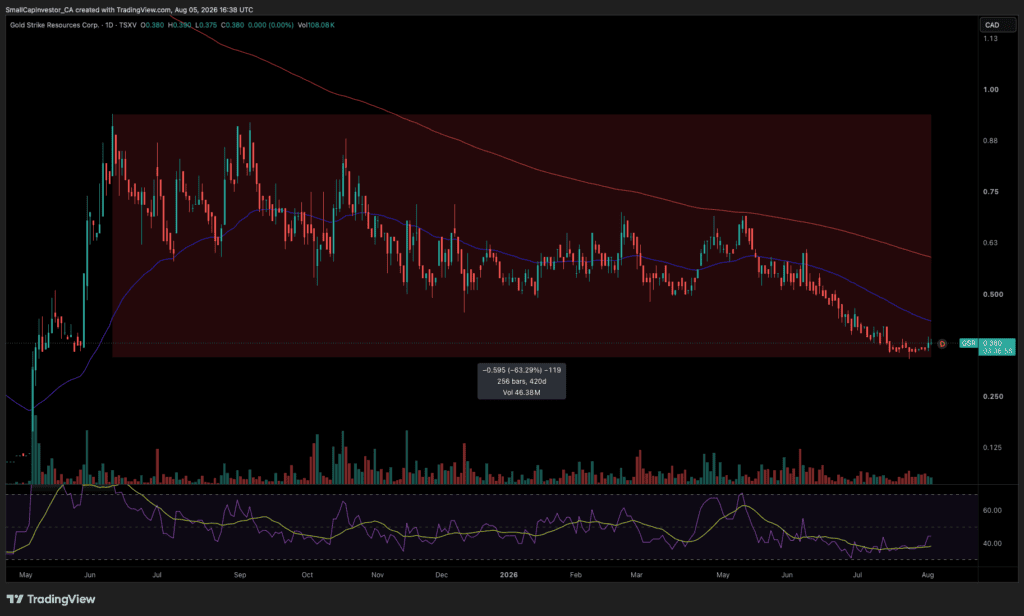
The share price has fallen sharply, but the underlying story has continued to improve. Gold Strike completed the acquisition of the Florin Gold Project, raised more than $17 million and has now started a fully funded drill program on an existing 2.5-million-ounce gold resource. The first assay results should begin arriving shortly.
At the same time, the company controls an extremely strategic land position surrounding Snowline Gold’s Valley deposit, one of the most impressive undeveloped gold deposits in Canada. In my view, Gold Strike gives investors two separate ways to win. The first is the strategic value of Gold Strike One and Gold Strike Two beside Snowline. The second, and the part that could create the most immediate value, is Florin.
A Call Option on Snowline Gold
Gold Strike One sits immediately beside Snowline Gold’s Valley deposit and borders the project from multiple directions. Its southern boundary is located less than 500 metres from the southern extent of Snowline’s interpreted resource pit.
This is not simply a junior owning land somewhere in the same region as a successful discovery. Gold Strike owns ground that could become increasingly important if Valley advances toward mine development.
Snowline’s latest resource estimate outlines 7.94 million ounces of gold in the measured and indicated categories at 1.21 grams per tonne, plus another 0.89 million ounces inferred. That works out to roughly 8.8 million ounces of gold.
Valley has the size, grade, metallurgy and jurisdiction that major mining companies are looking for. In my opinion, it is only a matter of time before a serious acquisition offer arrives.
My view is fairly simple. Whoever eventually acquires Snowline may also need to acquire, option or negotiate access to Gold Strike’s surrounding land. Gold Strike has stated that Snowline’s proposed access route crosses Gold Strike One and that certain elements of the conceptual mine infrastructure overlap Gold Strike’s mineral tenure.
Road access, water management, waste storage and other infrastructure all require land. A major spending billions of dollars to acquire and develop Valley would likely want as much control over the surrounding area as possible. This is why I view Gold Strike as having a call option on a future Snowline transaction.
Gold Strike shareholders do not need Snowline to be acquired for the investment thesis to work. However, if a takeover does happen, GSR’s surrounding land could become very difficult for the buyer to ignore.
What the Rupert and Aurion Deal Tells Us
The recent Rupert Resources and Aurion Resources transactions provide a useful example of how a major miner may approach this type of situation.
In April 2026, Agnico Eagle announced the acquisition of Rupert Resources for approximately C$2.9 billion. Rupert owned the advanced Ikkari gold project in Finland. At the same time, Agnico agreed to acquire Aurion Resources for approximately C$481 million.
Aurion did not have a major defined resource comparable to Ikkari. Its value came largely from its strategic land package surrounding Rupert and Agnico’s existing interests in the Central Lapland Greenstone Belt. Agnico did not simply buy the main deposit. It bought the surrounding land as well, giving it control of the broader district and reducing the chance of future infrastructure or ownership complications.
I see a clear parallel with Snowline and Gold Strike. Snowline controls the main deposit at Valley, while Gold Strike controls strategically located ground around it. The situations are not identical, but the lesson is relevant. Once a major decides it wants to develop a large mine, surrounding land can quickly become far more valuable than the market previously believed.
For a major gold producer, acquiring Gold Strike could be a relatively small cost compared with the total amount required to acquire and develop Snowline. For Gold Strike shareholders, however, it could be transformative.
Florin Is the Real Prize
The Snowline angle is exciting, but it is not the main reason I own Gold Strike. The real reason is the Florin Gold Project.
Florin already hosts a pit-constrained inferred resource of 2.507 million ounces of gold. The resource contains approximately 162.8 million tonnes grading 0.48 grams per tonne gold at a cut-off grade of 0.30 grams per tonne.
This is not a grassroots exploration company drilling an untested anomaly and hoping to get lucky. Gold Strike already owns a large gold deposit. The question is how much larger and better Florin can become.
The current resource has a projected strike length of approximately 925 metres and remains open laterally in every direction and at depth. It also sits within a much broader five-kilometre gold-in-soil anomaly containing high-grade rock samples and several geophysical targets.
That is what makes Florin so interesting. Gold Strike already has 2.5 million ounces, yet the existing resource only covers part of a much larger mineralized footprint. The current drilling could show that Florin is not simply one isolated deposit, but part of a much larger gold system.
Florin is also located adjacent to Sitka Gold’s RC Gold Project, one of the most closely followed exploration stories in the Tombstone Gold Belt. Sitka’s success has brought more attention to the region and helped demonstrate the potential for large intrusion-related gold systems across the district.
This puts Gold Strike in a unique position. Gold Strike One and Gold Strike Two provide exposure to the land surrounding Snowline’s Valley deposit, while Florin provides an existing 2.5-million-ounce resource beside Sitka. Gold Strike is not just another nearology story trading on the success of its neighbours. The company owns a major resource of its own.
Gold Strike Is Fully Funded
One of the biggest problems with junior mining companies is that they often do not have enough money to properly test their projects. They raise a small amount of capital, drill a few holes and then return to the market for another financing.
Gold Strike is in a much stronger position. The company raised more than $17 million earlier this year, giving it enough capital to complete a meaningful drill and exploration program at Florin. The financing was completed at $0.55 per share, well above where the stock has recently been trading.
This allowed Gold Strike to plan more than 8,000 metres of drilling rather than a small program consisting of only a handful of holes. The money has been raised, the Florin acquisition has closed and the rigs are turning. The market is now waiting for results.
Drilling Is Finally Underway
Gold Strike announced the commencement of drilling at Florin on July 9, 2026. The full program includes more than 8,000 metres of diamond drilling, with the first 10 holes accounting for approximately 5,000 metres.
Those initial holes are targeting the higher-grade and unconstrained southwestern portion of the existing resource. This is the area I am most interested in because historical drilling suggests the southwestern part of the deposit may contain stronger grades, while the mineralization remains open.
The company is also testing major gaps in the existing drill coverage and potential extensions of higher-grade zones identified at depth. The remaining metres are expected to be used for step-out exploration drilling across the broader five-kilometre gold-in-soil anomaly, along with high-grade rock sample locations and geophysical targets outside the current resource footprint.
This gives the program several different ways to create value. Gold Strike could expand the current resource, connect areas that were previously separated by gaps in historical drilling, identify wider or higher-grade portions of the deposit or discover entirely new mineralized zones outside the current resource.
The company is also collecting geotechnical information and metallurgical samples to support the future advancement of Florin. This is not simply drilling for headlines. Gold Strike is beginning to gather the information required to move the project forward.
What I Expect From the Drill Results
I expect the initial holes to be mineralized. Gold Strike is drilling into and around an existing 2.5-million-ounce resource, with the first holes targeting one of the more attractive and less constrained parts of the deposit.
The more important questions are the widths, grades and continuity of the mineralization. Does the gold continue outside the current resource model? Can the company connect mineralized zones across gaps in the historical drilling? Can it identify stronger grades that improve the overall quality of the deposit? Can Florin grow well beyond its current 2.5-million-ounce resource?
Gold Strike has said assay results are expected within approximately three weeks of core being delivered to the laboratory. Initial results from the first drill hole were anticipated in early August, with assays expected to be released on a hole-by-hole basis as they become available.
That means Gold Strike could be entering a period of steady news flow throughout the remainder of the drill season. Strong results would not only confirm the existing geological model. They could also show that Florin is larger and potentially higher grade than the market currently gives it credit for.
Grade will be particularly important. Florin is already a large deposit, but the current resource grade is 0.48 grams per tonne gold. Adding more ounces would be positive, but identifying wider and more continuous zones of stronger-grade mineralization could have a much greater impact on how the project is viewed.
This is why the first 10 holes matter so much. The company is not simply trying to make Florin bigger. It is also trying to show that there may be better-quality ounces within the broader system.
The Story Has Improved While the Stock Has Weakened
Gold Strike’s share price has been weak since the financing and completion of the Florin acquisition. The company raised capital at $0.55, completed a transformative acquisition and started drilling, yet the market has not rewarded it.
I see that disconnect as the opportunity.
When I first became bullish on Gold Strike, the Florin acquisition had not closed, the financing had not been completed and drilling had not started. Those milestones have now been achieved. Gold Strike owns Florin, has more than 2.5 million ounces of gold in the ground, has the capital to complete its program and has two rigs working at the project.
The story is in a stronger position today than it was earlier in the year, yet the stock is down approximately 63% from its peak. That is exactly the type of setup I look for in the junior mining sector.
Why Gold Strike Is Still My Top Gold Pick
Gold Strike remains my top gold pick for 2026 because it offers a combination that is difficult to find elsewhere. The company controls strategically important land around Snowline’s Valley deposit, owns a 2.5-million-ounce gold resource beside Sitka Gold, has more than $17 million in fresh capital and is completing a fully funded drill program of more than 8,000 metres.
The Snowline angle gives Gold Strike a potentially valuable M&A wildcard, but the investment does not depend on that transaction happening. Florin can create value on its own.
If the drilling expands the deposit, confirms stronger grades or shows that the broader five-kilometre anomaly contains additional mineralized zones, the market may be forced to look at Gold Strike very differently.
The stock has weakened, but the company has continued to execute. The story is better today than it was when the share price was a lot higher. That is why I remain bullish, and why Gold Strike is still my top pick in the gold space for 2026.
DISCLOSURE: The author did not receive any compensation for publishing this article. The author holds a position in Goldstrike Resources Corp and may choose to buy or sell shares of the company at any time without notice. The author does not hold positions in any of the other companies mentioned. While reasonable efforts have been made to ensure the accuracy and reliability of the information provided, readers are encouraged to conduct their own research and seek independent financial advice before making any investment decisions related to the companies discussed