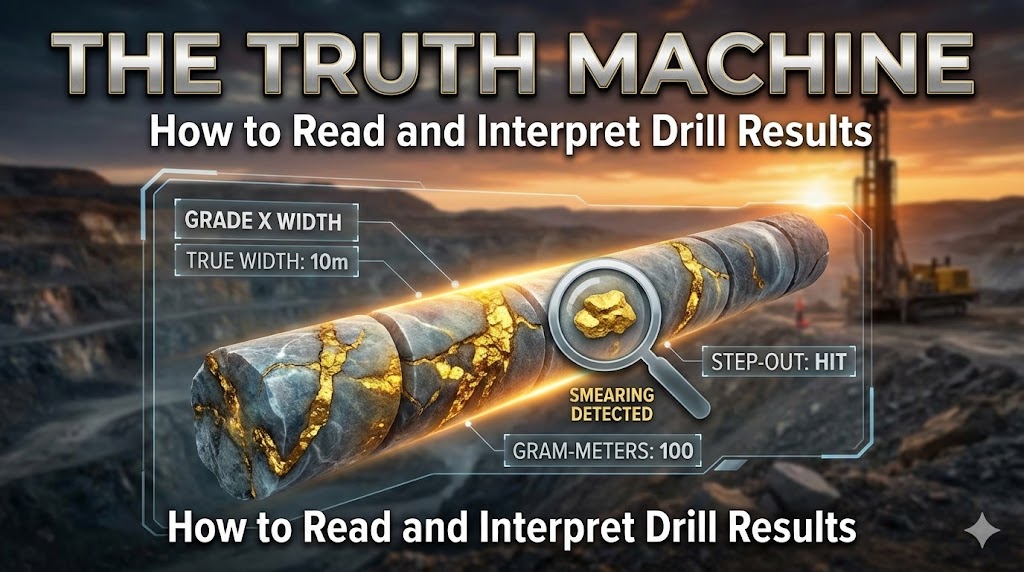
For investors in the junior mining sector, the press release announcing “drill results” is the single most important document you will read. It is the binary event that determines whether a stock gaps up 50% at the open or quietly bleeds out over the next six months.
But for the uninitiated, these releases are often designed to confuse. They are walled gardens of technical jargon, geological acronyms, and selective math. You might see a headline boasting “100 meters of 1.5 g/t Gold,” but without context, that number is meaningless. Is it near the surface? Is it a true width? Is it consistent, or is it “smeared”?
In this guide, we will hand you the keys to the “Truth Machine.” We will break down the anatomy of a drill result, teach you the mathematical shortcuts pros use, and show you how to spot the red flags that retail investors often miss.
1. The Magic Formula: Grade x Width (Gram-Meters)
The first question every investor asks is: “Is this a good hole?” The quickest way to answer this is by calculating Gram-Meters (often called “Grade-Thickness”). This gives you a single, standardized number to rank the strength of an intercept across different projects.
The Formula
Grade (g/t) × Interval Length (meters) = Gram-Meters
Example:
- Drill Hole A: 2 meters at 20 g/t Gold = 40 Gram-Meters
- Drill Hole B: 100 meters at 0.5 g/t Gold = 50 Gram-Meters
Which hole is better? Surprisingly, Drill Hole B scores higher. While the grade is lower, the sheer volume of mineralized rock suggests a large, bulk-tonnage target (like an open pit), whereas Drill Hole A is a narrow vein that might be too thin to mine profitably.
Benchmarks: What is “Good”?
While every deposit is unique, here are general rule-of-thumb benchmarks for a Gold intercept:
- < 10 Gram-Meters: Generally insignificant unless it is right at the surface (e.g., 10m @ 1 g/t).
- 10 – 50 Gram-Meters: A solid result that warrants follow-up drilling.
- 100+ Gram-Meters: A world-class intercept. (e.g., 20m @ 5 g/t or 100m @ 1 g/t). These are the holes that build mines.
Pro Tip for Other Metals: You can apply similar logic to Silver and Copper using “Equivalents.”
- Silver: A benchmark for high-grade is often considered >500g/t over reasonable widths.
- Copper: Anything over 100 meters of 1% Copper Equivalent is generally considered a top-tier result.
2. The Geometry Trap: True Width vs. Apparent Width
This is the most common “optical illusion” in mining. Drill rigs rarely cut perfectly perpendicular to a mineral vein; they often cut at an angle.
Imagine a loaf of bread (the gold vein) that is 10cm thick.
- True Width: If you stick a skewer straight through the slice, the distance is 10cm.
- Apparent Width: If you stick the skewer in at a 45-degree angle, the distance inside the bread might measure 14cm. If you go in from the side (down-dip), you could travel 30cm through the same slice!
Why It Matters
Companies love to report Apparent Width because it makes the mineralized zone look thicker than it is.
- If a drill hole hits a vein at a 30-degree angle, the “Apparent Width” reported in the headline can be 2x the True Width.
- At an extreme 10-degree angle, the apparent width can balloon to nearly 6x the actual thickness.
The Red Flag: If a company reports massive intervals but does not mention “True Width” or the orientation of the hole (Dip/Azimuth), be skeptical. They may be drilling “down the throat” of a narrow vein to create a headline-grabbing number.
3. Step-Out vs. Infill: The “Why” Behind the Hole
Not all drill holes have the same purpose. Understanding the intent of the drilling program is critical for managing your expectations.
Step-Out Drilling (High Risk / High Reward)
This is exploration in its purest form. The drill rig moves 50m, 100m, or even 500m away from the known mineralization to see if the deposit grows.
- The Goal: Expand the size of the resource.
- The Stock Reaction: Success here adds “Blue Sky” potential. A hit on a wide step-out is the primary driver of parabolic stock moves.
Infill Drilling (De-Risking)
The drill rig targets the gap between two successful holes.
- The Goal: Prove continuity. This data is used to upgrade a resource from the “Inferred” category (guesswork) to “Indicated” (bankable).
- The Stock Reaction: Usually muted. Investors expect these holes to hit. If an infill hole misses, it is catastrophic, as it breaks the geological model and erases assumed ounces.
4. “Smearing” the Grade
Investors often scan the headline, see a high number, and buy. Companies know this, and they sometimes use a technique called “smearing” to dress up a mediocre result.
The Smearing Example:
- Headline: “10 meters at 5.0 g/t Gold”
- The Reality: The assay table shows:
- 1 meter at 49.1 g/t (a nugget)
- 9 meters at 0.1 g/t (waste rock)
Technically, the math is correct: the average of that 10-meter interval is indeed 5.0 g/t. However, you cannot mine that. The 9 meters of waste rock would dilute the 1 meter of high-grade ore, likely making the whole block uneconomic.
How to Spot It: Always look for the “Including” line in the sub-text. A transparent company will write: “10 meters at 5.0 g/t, including 1 meter at 49.1 g/t.” If the “including” section carries all the value, the rest of the interval is likely barren.
5. Depth and Location: The Economics of the Hit
Finally, context is King. A drill intercept does not exist in a vacuum; it exists in the earth, and it costs money to dig it out.
- Open Pit Potential: If a result is near-surface (0m to 200m depth), lower grades (e.g., 0.5 g/t to 1.5 g/t Gold) can be highly profitable because digging an open pit is cheaper.
- Underground Potential: If the intercept is deep (400m+), the grade needs to be significantly higher (usually >3.0 – 5.0 g/t Gold) to justify the massive expense of building underground tunnels and ventilation shafts.
The Trap: A “100m at 1.0 g/t” hit is a company-maker at the surface. That same hit at 800m depth might be stranded forever because it’s too expensive to reach.
Conclusion
Reading drill results is an art form that blends geology, geometry, and finance. By looking past the headline and calculating the Gram-Meters, checking for True Width, identifying the Drill Type, and scanning for Smearing, you can separate the legitimate discoveries from the lifestyle-company promotions.