
Artificial intelligence may be a transformative technology and still produce a damaging investment bubble. The key question is whether the value being created can justify the enormous amount of capital being committed to build it.
“Is AI a bubble?” sounds like a question with a yes-or-no answer. It isn’t.
A technology can be real, useful and economically important while investors overestimate how quickly it will pay off or which companies will capture the gains. That distinction matters. The internet changed the world, but many internet stocks still went to zero. Railroads reshaped commerce, but excessive investment helped trigger one of the great financial panics of the nineteenth century.
The AI buildout has elements of both stories. Companies are reporting real demand and putting enormous sums into data centres, chips and power. At the same time, the scale of that investment is raising a harder question: will the profits arrive fast enough to justify it?
A real technology and a very large bill
AI is already being used across businesses, from coding and customer service to research and data analysis. McKinsey’s 2026 survey found that nearly nine in ten respondents said their organizations regularly used AI in at least one business function, while 44% said AI was scaling across their enterprise. But adoption alone doesn’t establish that the investment is earning an attractive return.
That gap between use and payoff is central to the debate. A separate Gartner survey found that only 13% of organizations reported achieving significant or transformational value from AI. Surveys use different definitions and measure different things, so their results aren’t directly comparable. Together, though, they suggest a technology that is spreading quickly while many companies are still working out how to turn it into lasting economic value.
The infrastructure spending is already enormous. Reuters reported that Alphabet, Microsoft, Amazon and Meta are expected to spend well over US$700 billion collectively in 2026 to expand data-centre capacity, chips and networking. Alphabet maintained its 2026 capital-spending forecast of US$195 billion to US$205 billion after reporting third-quarter results, while indicating that spending would rise significantly in 2027.
Those numbers don’t prove a bubble. They do raise the stakes. The more capital companies commit upfront, the more investors need to see evidence that customers will keep paying for the capacity and that the revenue will eventually produce adequate returns.
The market’s reaction to Alphabet’s latest results illustrates the shift. Investors focused not only on AI demand, but also on the company’s cash spending and the performance of its core advertising business. The debate is moving beyond whether AI is important. It is increasingly about who will earn a return on the investment, how soon, and at what cost.
The pressure is already visible beneath the headline AI trade. By October 22, a screen of U.S.-traded AI buildout suppliers and infrastructure companies found dozens of stocks down at least 40% from recent highs, with several down more than 50%. The hardest-hit names included data-centre landlords, power and construction companies, and optical-networking suppliers. That doesn’t mean every AI stock has suffered the same decline: the sell-off has been concentrated in parts of the infrastructure chain, while the largest technology companies have generally held up better.
That distinction matters when reading the psychology chart. Some parts of the AI market may already be moving from excitement into anxiety, even as belief in AI’s long-term potential remains strong. A sharp drawdown in one group of stocks doesn’t prove the entire sector is in a bubble or that the technology has failed. It does show that investors are starting to separate the AI opportunity from the companies and valuations most exposed to the cost of building it.
The railroad lesson: useful infrastructure can still be overbuilt
Railroads are a useful comparison because they were not a passing fad. They transformed trade and travel, connected distant markets and supported economic growth. But the fact that the technology was valuable did not mean every railway project was sound.
In the years before the Panic of 1873, railroad construction expanded rapidly. New projects eventually outpaced demand for capacity, returns declined, and some companies struggled to finance operations and repay debt. When European investors pulled back from American securities, railroad companies and the banks tied to them came under severe pressure. The failure of Jay Cooke & Co., which was heavily exposed to railway financing, helped turn that stress into a broader panic.
The parallel is not that data centres are railways. It is that transformative infrastructure can be built ahead of profitable demand. If that happens, the technology and infrastructure may remain useful even as investors in particular companies suffer losses.
That is one of the most important lessons for AI investors: the future can arrive and still disappoint the people who paid too much for it.
The dot-com lesson: the winners and the losers aren’t obvious in advance
The internet boom offers a closer comparison in the speed of adoption and the enthusiasm around a new technology. The commercial internet was real. So was the financial excess around it.
The Nasdaq rose rapidly during the late 1990s, reaching its peak in March 2000. It later fell about 77% from that peak by October 2002. Many companies had been valued on ambitious expectations despite having little revenue or profit.
That history doesn’t mean today’s largest AI companies are equivalent to dot-com startups with no viable business. Many of the current AI investors are highly profitable companies with established customers and substantial existing cash flows. That gives the current cycle a different financial foundation.
But the underlying investment risk remains recognizable. The companies spending the most may not be the ones that ultimately capture the most value. A company can build a valuable product, attract users and still struggle to earn enough to cover its costs. And investors can be right about the technology while being wrong about a company’s valuation, timing or competitive position.
Reading the psychology chart
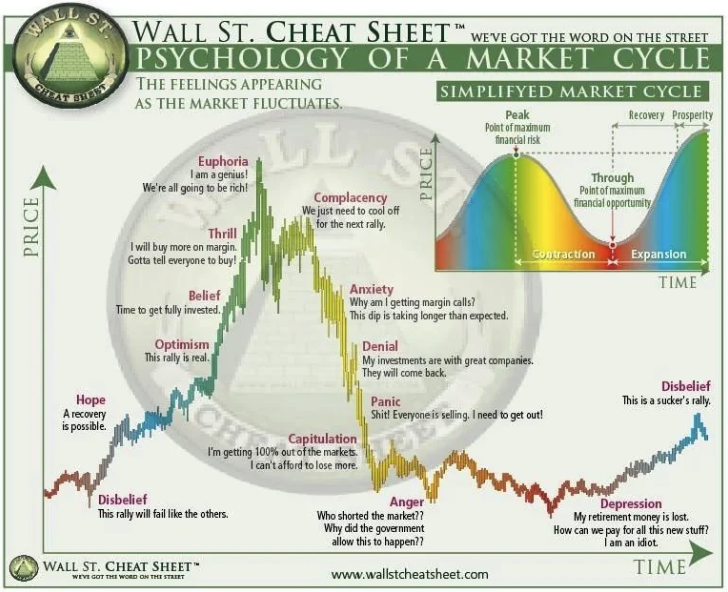
The chart is a useful way to describe how investor attitudes can change: optimism turns into belief, then excitement and euphoria; after a reversal, confidence gives way to anxiety, denial and panic. But it is a simplified illustration, not a tool that can identify the exact stage of a live market.
For AI, I would describe the mood as shifting from broad optimism and excitement toward greater scrutiny. Some investors still expect AI to transform the economy and are willing to fund enormous infrastructure plans. Others are now asking whether rising capital spending will translate into profits or consume cash without producing adequate returns. The recent reaction to Alphabet’s results is one sign of that more demanding mood.
That does not mean the AI market has reached panic or capitulation. Nor does it mean every AI-related investment is in the same phase. Investors in established chipmakers, cloud providers, software companies and early-stage AI firms face different expectations and risks. A single chart cannot place all of them at one point on one curve.
So, is AI a bubble?
There is a strong case that AI is a major technological shift. There is also a reasonable case that parts of the market are pricing in a future that remains uncertain.
Those statements can both be true. The railroad and dot-com episodes show that durable technologies do not protect investors from overbuilding, weak business models or unrealistic valuations. Today’s large AI spenders have stronger operating businesses than many dot-com companies did, but their investments still need to earn a return.
The clearest signs to watch are practical ones: whether customers keep adopting AI, whether that adoption produces measurable value, whether cloud and AI revenues grow alongside infrastructure spending, and whether companies can generate healthy cash flows after paying for the buildout.
The psychology chart points to a market beginning to ask harder questions. That is not proof the AI boom is over or proof that it has further to run. It is a reminder that the next phase may depend less on how exciting the technology sounds and more on whether the economics work.