
The Iran war has exposed a more complicated truth about gold: geopolitical fear can support bullion, but the economic consequences of a conflict can push it lower.
Gold has been one of the market’s most powerful trades in recent years. It surged to a record near US$5,595 an ounce in January 2026, then gave back roughly 30% as the Iran war reshaped the outlook for oil, inflation and interest rates. In early November, bullion was trading around US$3,900, well below its high, despite the ongoing conflict.
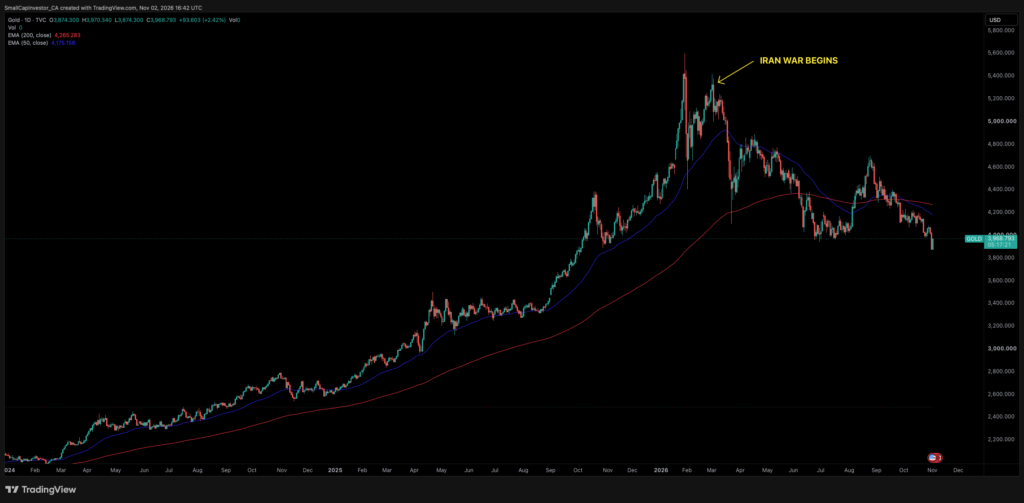
That looks like a failure of gold’s safe-haven role. It is better understood as a collision between two forces. The war increased demand for protection, but it also created an energy shock that strengthened the U.S. dollar and pushed rate expectations higher. Those forces have weighed on a metal that pays no interest.
Our view is that this pullback may be creating a generational buying opportunity. If the conflict ends and oil-market pressure eases, some of the biggest headwinds facing gold could reverse. Combined with the longer-term reasons investors and central banks have been accumulating bullion, that could set the stage for a return to, and potentially break above, the January high.
That is a thesis, not a certainty. Understanding the mechanism matters more than simply assuming that war means higher gold.
Why hasn’t gold rallied during the war?
Gold is often called a safe-haven asset, but it does not respond to geopolitical headlines in isolation. Its price reflects the balance between demand for protection and the opportunity cost of holding a non-yielding asset. Real interest rates, the U.S. dollar, investor liquidity and market positioning can all matter more in the short term than the conflict itself.
1. The oil shock changed the rate outlook
The Iran conflict put energy supply and shipping routes under pressure. Higher oil prices can feed into transportation, production and consumer costs, renewing concern about inflation. If investors believe inflation will stay elevated, they may expect central banks to keep interest rates higher for longer, or even tighten policy further.
That is a problem for gold. Bullion pays no coupon or dividend. When inflation-adjusted bond yields rise, investors can earn more from cash and bonds while holding gold becomes more expensive in opportunity-cost terms. Morgan Stanley’s analysis of gold’s decline after the conflict began made this point directly: the energy shock reduced expectations for easier U.S. monetary policy, making real rates a more important driver than the war’s safe-haven effect.
2. A stronger dollar competed with gold for safe-haven flows
Gold is priced globally in U.S. dollars. When the dollar rises, gold becomes more expensive for buyers using other currencies, which can dampen demand. The dollar can also attract its own safe-haven flows during a crisis, competing with bullion for investor capital.
Reuters reported that the dollar strengthened after the Iran war began, supported by higher U.S. rates, economic resilience and the United States’ position as an energy exporter. In that environment, investors seeking safety did not have to choose gold alone.
3. Investors sold liquid winners to raise cash
There is another, less intuitive force at work during sharp market stress: investors sometimes sell what they can, not only what they want to sell. Gold had risen dramatically before the conflict. When other assets fell and margin pressure increased, bullion was a liquid holding that investors could sell to cover losses or raise cash.
Reuters described this kind of selling after the war began, as investors took profits in gold to meet losses elsewhere. The result can be a short-term decline in gold even while the underlying appetite for protection remains intact.
These forces help explain the apparent contradiction. The conflict increased geopolitical risk, but it also pushed oil, rate expectations and the dollar higher, creating episodes of forced selling. For a period, those financial effects outweighed the safe-haven bid.
Why a war ending could be bullish for gold
The bullish case is not that peace automatically makes gold rise. An end to the fighting could reduce some immediate demand for a geopolitical hedge. The argument is that a durable settlement could also unwind the oil-driven inflation shock and the financial conditions that have weighed on bullion.
If energy prices fall as supply and shipping normalize, markets may become less concerned about another wave of inflation. That could reduce expectations for further rate hikes and bring bond yields lower. If real yields ease, the opportunity cost of holding gold falls. If the dollar’s crisis bid fades at the same time, that removes another headwind.
A calmer market could also reduce forced selling. Investors who liquidated gold to meet margin calls may no longer need to sell, while longer-term investors may be more willing to rebuild positions. Gold’s recent weakness could therefore be partly cyclical and flow-driven, rather than proof that its long-term role has changed.
The market’s reaction to peace-talk headlines offers a real-time example of this mechanism. On November 2, Reuters reported that gold rebounded after oil fell more than 6% amid renewed hopes for talks to end the conflict. Easing inflation concerns, lower expectations for interest rates and a softer dollar all helped support bullion. One session does not prove the full thesis, but it shows how quickly the oil-rate-dollar channel can affect gold.
The longer-term case extends beyond the war
Even if the geopolitical premium fades, the forces that helped gold reach record highs have not necessarily disappeared. Central banks have continued to diversify reserves, and governments face large debt burdens that raise questions about the long-term purchasing power of fiat currencies. Investors may also seek assets that do not depend on the promise or solvency of a particular issuer.
Central-bank demand has not moved in a straight line. The World Gold Council reported that net purchases rose to 289 tonnes in the second quarter of 2026, following a slower first quarter. It expected central banks to remain significant buyers, while noting that full-year demand could finish below 2025’s total. That is a supportive structural factor, not a guarantee of uninterrupted buying.
China provides a more direct example of official buying continuing through the pullback. The People’s Bank of China reported adding 23 tonnes of gold in September, its largest monthly purchase since October 2023. That extended its buying streak to 23 consecutive months, brought its third-quarter purchases to 63 tonnes and lifted its year-to-date additions to 103 tonnes through September. The World Gold Council specifically noted that the PBoC continued buying despite the declining gold price. This is evidence that China kept adding to reserves during the correction, although it does not prove that price declines alone drove those purchases or that official buying sets a firm floor under the market.
Gold also has a history of large drawdowns within longer advances. The World Gold Council’s mid-year 2026 analysis found that, in the historical episodes it reviewed since 1971, declines of 20% or more from a record high had a median drawdown of 29% and an average drawdown of 36%. A major correction is painful, but it is not, by itself, proof that a long-term bull market is over.
What would it take to make new highs?
From roughly US$3,900 an ounce, gold would need to rise about 44% to exceed its January high near US$5,595. That is a substantial move. A peace deal alone may not be enough. The more complete bullish scenario would involve several factors working together: oil prices retreating, inflation pressure easing, real yields and the dollar weakening, and longer-term investment and central-bank demand continuing.
There are also clear risks to the thesis. A ceasefire might not restore energy flows quickly. Oil could remain elevated, keeping inflation and interest rates high. Strong U.S. economic data could support the dollar and bond yields. Central-bank buying or investor demand could weaken. In any of those cases, gold could remain under pressure or fall further, even after the fighting stops.
The International Monetary Fund has emphasized that gold’s safe-haven response depends on the financial channels a shock activates. Geopolitical risk can support gold, but higher real rates and a stronger dollar can work in the opposite direction. That is why the path from war to a new gold record is not automatic.
A correction that may be creating opportunity
Gold’s behaviour during the Iran war is not evidence that it has stopped being a safe-haven asset. It is a reminder that safe-haven demand is only one part of the price equation. This time, the war also delivered an oil shock, revived the prospect of higher interest rates, supported the dollar and contributed to forced selling.
If the war ends and those pressures unwind, gold could recover even as immediate geopolitical fear subsides. If the longer-term demand for reserve diversification and protection from currency and debt risks remains in place, a return to all-time highs becomes plausible.
We believe the decline from roughly US$5,600 to US$3,900 has created an unusually attractive entry point for patient gold investors. The opportunity is generational in our view because the pullback has been severe while the structural case for owning gold remains intact. The next move is not guaranteed, and investors should be prepared for volatility. But if the oil shock fades and financial conditions turn more supportive, today’s pessimism could look very different in hindsight.
Sources
- Reuters, “Gold rises over 1% from one-year low on softer oil prices; US midterms in focus,” November 2, 2026: https://www.reuters.com/world/india/gold-rises-softer-oil-markets-parse-fed-signals-2026-11-02/
- Reuters, “How safe havens stack up as tech, energy and France fears grip markets,” October 20, 2026: https://www.reuters.com/business/energy/global-markets-safe-havens-graphic-pix-2026-10-20/
- Morgan Stanley, “Is Gold Still a Safe Haven?,” May 5, 2026: https://www.morganstanley.com/insights/articles/gold-prices-safe-haven-status-reality-check-iran-conflict
- International Monetary Fund, “Gold in Central Bank Reserves: Strategic Considerations, Market Risks, and Practical Guidance,” 2026: https://www.elibrary.imf.org/view/journals/068/2026/007/article-A001-en.xml
- World Gold Council, “Gold Mid-Year Outlook 2026: Point break,” June 2026: https://www.gold.org/goldhub/research/gold-mid-year-outlook-2026
- World Gold Council, “Gold Demand Trends: Q2 2026: Central Banks,” July 30, 2026: https://www.gold.org/goldhub/research/gold-demand-trends/gold-demand-trends-q2-2026/central-banks
- World Gold Council, “China gold market update: Q3 ends with strong official gold buying,” October 2026: https://www.gold.org/goldhub/gold-focus/2026/10/china-gold-market-update-q3-ends-strong-official-gold-buying