
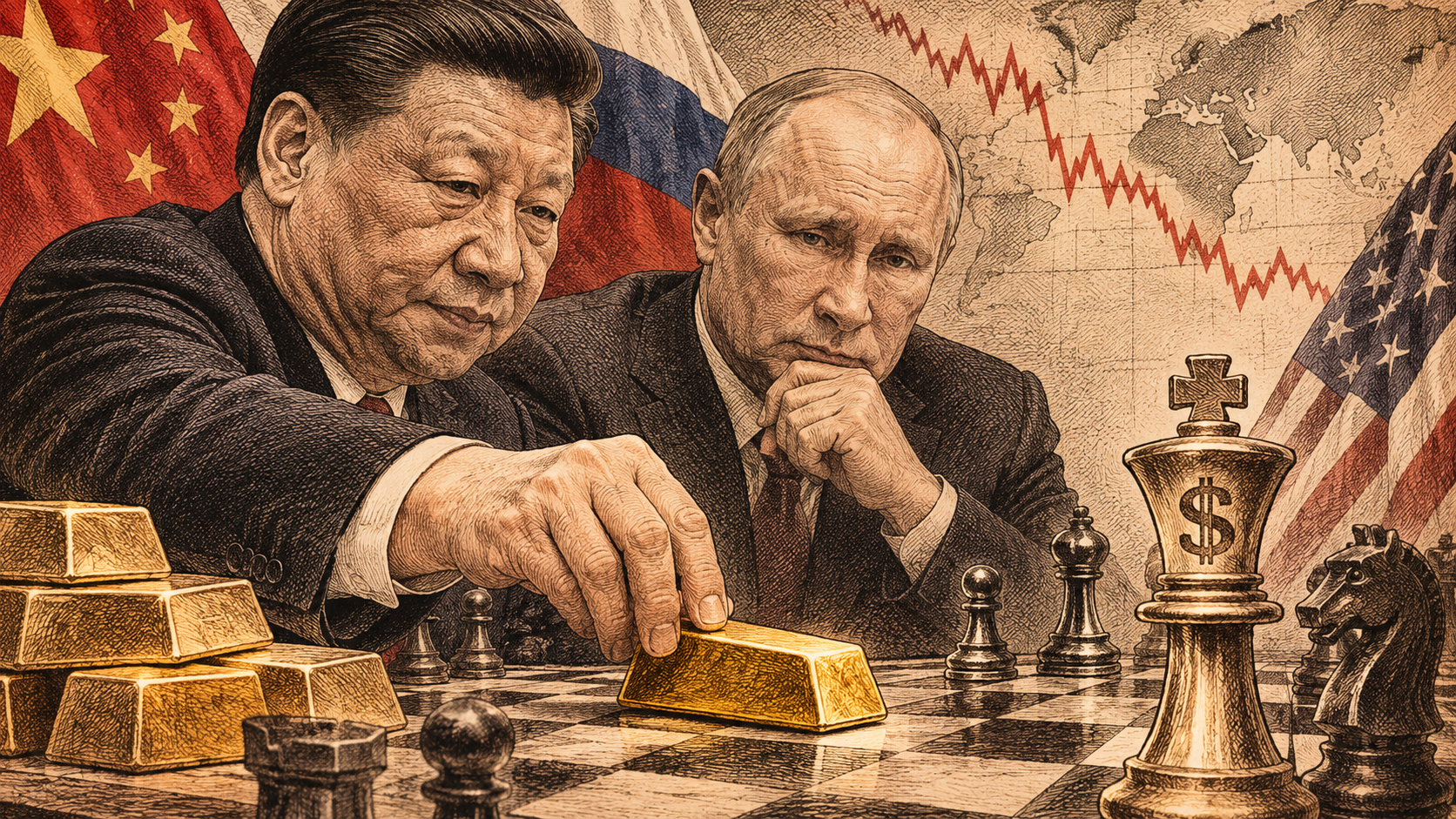
Could the paper precious metals market be facilitating a strategic accumulation of physical bullion ahead of a broader shift away from the US dollar?
Most of the articles I publish on SmallCapInvestor are grounded in fundamental analysis, economic data and factual research. Today, I want to take a slightly different approach.
I’m not usually one for conspiracy theories, and I’ll admit that what I’m about to discuss is a little out there. However, it’s something I’ve been thinking about lately, and I believe there is enough merit to the theory to warrant a conversation.
I’m not presenting this as fact, nor am I claiming to have evidence that this is actually happening. Rather, I want to explore a possibility that, when viewed through the lens of geopolitics, monetary policy and the mechanics of the precious metals market, might not be as far-fetched as it initially sounds.
What if certain BRICS nations deliberately engineered, or at the very least amplified the velocity of, the recent precious metals crash through the paper market in order to accumulate physical bullion at significantly depressed prices ahead of a broader strategic shift away from the US dollar?
Before dismissing the idea entirely, I think it’s worth examining the economic and geopolitical incentives that could make such a strategy appealing.
Putting the Gold Crash Into Historical Perspective
Before getting into the theory itself, I think it’s worth taking a step back and looking at the price of gold over the past 50 years.
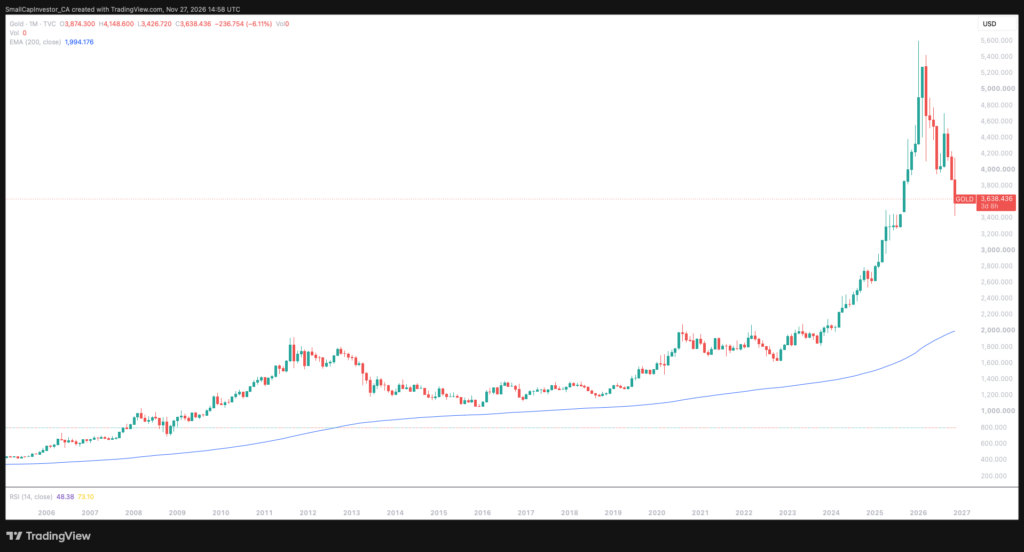
What stands out to me about the recent collapse in gold prices isn’t necessarily the magnitude of the drawdown, but the velocity at which it has occurred.
Gold has experienced several major bear markets over the past half-century. What makes the current sell-off particularly interesting is how much value has been erased in such a compressed period of time.
After reaching approximately US$5,600 per ounce earlier this year, gold has fallen to around US$3,500 per ounce, representing a decline of approximately 37.5%.
The speed of this repricing is particularly interesting when you consider the longer-term geopolitical and monetary incentives driving sovereign demand for physical gold.
While the velocity of the sell-off is not evidence of manipulation in itself, it does raise an interesting question: could certain market participants have had a strategic incentive to accelerate an already significant correction?
That is the possibility I want to explore.
The World’s Relationship With the US Dollar Is Changing
For decades, the US dollar has been the foundation of the global financial system. International trade, commodity transactions, sovereign reserves and global debt markets have all been heavily dependent on the dollar.
However, in recent years, a growing number of countries have expressed interest in reducing that dependence.
This has been particularly evident among certain BRICS nations, most notably China and Russia.
The freezing of Russian foreign exchange reserves in 2022 was arguably one of the most consequential events in modern monetary history. It demonstrated that a country’s foreign currency reserves, regardless of their size, could become inaccessible under certain geopolitical circumstances.
For nations that are not politically aligned with the United States, this introduced an additional consideration when determining how to store their sovereign wealth.
Physical gold, when held domestically, offers a solution to some of these concerns.
It carries no foreign sovereign counterparty risk. It cannot be printed into existence. It does not require another country’s banking infrastructure to establish ownership.
It is an asset that has maintained monetary relevance for thousands of years.
It should therefore come as little surprise that central banks have been among the most significant buyers of physical gold in recent years.
According to the World Gold Council, central banks purchased more than 1,000 tonnes of gold annually in 2022, 2023 and 2024, representing a substantial acceleration relative to historical purchasing levels.
The desire to diversify away from the US dollar is not a conspiracy theory. It is a documented development in the global financial system, although its pace and significance remain subject to debate.
The speculative part of my theory concerns how certain nations might go about facilitating that transition.
The Problem With Accumulating Gold at Record Prices
Imagine you are responsible for managing the foreign exchange reserves of a major economic power.
You hold hundreds of billions of dollars in US dollar-denominated assets and intend to gradually convert a portion of those reserves into physical gold over the next decade.
Your objective is not to generate a quarterly return. You are not concerned with technical analysis, earnings season or whether gold is trading above its 200-day moving average.
Your objective is to accumulate as much physical gold as possible.
There is, however, a problem.
As more countries pursue similar strategies, their collective demand contributes to upward pressure on the price of gold, making further accumulation increasingly expensive.
Consider the economics of accumulating physical gold on a sovereign scale.
At US$5,600 per ounce, acquiring 1,000 tonnes of physical gold would cost approximately US$180 billion. At US$3,500 per ounce, that same quantity would cost just US$112.5 billion.
That’s a difference of US$67.5 billion.
Put another way, a nation deploying the same amount of capital at today’s depressed prices could theoretically accumulate 60% more physical gold, assuming sufficient supply.
When you’re dealing with sovereign reserves of this magnitude, the financial incentive to drive down the acquisition cost of physical gold becomes increasingly apparent.
Which brings me to the paper market.
The Disconnect Between Paper and Physical Precious Metals
One of the most interesting characteristics of the modern precious metals market is that a substantial amount of price discovery occurs through financial instruments rather than the immediate exchange of physical bullion.
Futures contracts, options, forwards, unallocated bullion accounts and other derivatives allow market participants to gain exposure to gold and silver without necessarily taking physical possession of the underlying metal.
These instruments serve legitimate purposes, but they also introduce leverage into the market.
A financial institution can establish exposure to substantial quantities of gold or silver without committing the full capital required to purchase the equivalent amount of physical bullion.
This creates a market structure in which aggressive financial selling can exert significant downward pressure on the benchmark price of a physical commodity, even when the selling does not involve an immediate transfer of physical metal.
What makes this particularly interesting is the cascading effect that aggressive selling can have on a highly leveraged market.
As prices begin to decline, stop losses are triggered, leveraged positions are liquidated, margin calls are issued, systematic trading strategies begin selling and speculative capital rapidly exits the market.
Each subsequent wave of selling creates additional downward pressure, potentially triggering another round of liquidations.
Eventually, the selling can become self-reinforcing.
This is why I think the distinction between deliberately engineering a crash and deliberately amplifying the velocity of an existing crash is important.
You wouldn’t necessarily need to create the initial sell-off.
You would simply need to exploit it.
Could the Crash Have Been Amplified Intentionally?
There are several perfectly legitimate explanations for the recent collapse in precious metals prices.
A strengthening US dollar, rising interest rate expectations, deteriorating global economic conditions, excessive speculative positioning and broad-based deleveraging can all contribute to significant declines in commodity prices.
I’m not disputing any of those factors.
What I am questioning is whether certain market participants could have recognized these conditions as an opportunity to accelerate the decline.
Imagine that sophisticated, state-linked financial institutions were to establish substantial short exposure in the precious metals derivatives market at a time when speculative positioning was already vulnerable.
As prices declined and leveraged market participants were forced to liquidate, the resulting selling pressure could potentially drive prices considerably lower than the initial macroeconomic conditions alone might have warranted.
Meanwhile, sovereign entities operating independently of those financial positions could theoretically begin accumulating physical bullion at increasingly attractive prices.
The objective would not necessarily be to generate a profit from shorting precious metals.
The objective would be to reduce the acquisition cost of the physical asset.
Even if such a strategy came with substantial financial costs, those costs would have to be weighed against the potential savings associated with accumulating hundreds or thousands of tonnes of physical gold at significantly lower prices.
For an individual investor, such a strategy might make little sense.
For a sovereign nation with enormous foreign exchange reserves and a multi-decade geopolitical objective, the economics could look very different.
Of course, executing such a strategy would be considerably more complicated than it sounds. Large physical purchases would themselves create upward pressure on prices, short positions would carry significant risk, and other market participants could trade against the strategy.
But the existence of those challenges does not eliminate the underlying incentive.
The Strength of the US Dollar Makes This Even More Interesting
One of the more interesting developments in the current macroeconomic environment is the strength of the US dollar despite the longer-term narrative surrounding de-dollarization.
At first glance, these two developments might appear contradictory.
But consider the situation from the perspective of a country holding substantial US dollar reserves that it intends to gradually diversify into physical gold.
What would be the ideal environment in which to make that transition?
A strong US dollar and cheap gold.
The stronger the dollar becomes relative to gold, the greater the quantity of physical bullion that can be acquired using existing dollar reserves.
Ironically, the temporary strength of the very currency certain nations are attempting to reduce their dependence on could facilitate that transition.
I think people often misunderstand what de-dollarization actually means.
It does not necessarily require an immediate collapse of the US dollar. It does not require countries to liquidate all of their US Treasury holdings overnight, nor does it require the introduction of a new global reserve currency.
It can be a gradual process that takes place over decades through changes in sovereign reserve composition, bilateral trade agreements, alternative payment infrastructure and the accumulation of physical assets.
Periods of dollar strength and depressed gold prices could present particularly attractive opportunities to accelerate certain aspects of that process.
Where Silver Fits Into the Equation
While gold is the primary monetary asset at the centre of this theory, I also find the recent collapse in silver prices particularly interesting.
Unlike gold, silver has a dual identity.
It is both a precious metal and an important industrial commodity with applications across solar energy, electronics, electrification, advanced manufacturing and other strategically important industries.
For a manufacturing powerhouse such as China, the incentive to accumulate physical silver at depressed prices could extend well beyond monetary considerations.
It could also be a matter of securing access to strategically important industrial materials.
Silver’s relatively small market size and historically elevated volatility make it particularly susceptible to aggressive speculative positioning and forced liquidation events.
If substantial quantities of leveraged paper exposure are being liquidated while industrial consumers and long-term physical buyers continue accumulating the underlying metal, it is possible for financial market conditions and physical market conditions to tell somewhat different stories.
That is something I intend to pay close attention to.
However, I would distinguish between gold and silver in this discussion. Central bank gold accumulation is well documented, whereas evidence of coordinated sovereign silver accumulation is considerably less established.
The Difference Between Financial and Strategic Objectives
I think one of the biggest mistakes investors make when attempting to understand sovereign behaviour is assuming that governments approach markets with the same objectives as private investors.
A hedge fund is generally concerned with generating returns.
A retail investor is concerned with growing their portfolio.
A sovereign nation may be concerned with something entirely different: economic independence, resource security, geopolitical influence and financial resilience over the next several decades.
The strategic value of an asset may be more important than its short-term market performance.
A country accumulating physical gold as part of a long-term monetary strategy may actually welcome a significant decline in its price, particularly if that country remains a net buyer.
While retail investors panic over declining portfolio values and leveraged traders are forced to liquidate their positions, a sovereign buyer with substantial liquidity and no immediate need to sell may view the same environment as an opportunity.
The incentives are fundamentally different.
What Would Give This Theory More Credibility?
If there is any merit to this theory, I would expect certain developments to become increasingly evident over the coming months.
Among the things I will be watching are:
- An acceleration in central bank gold purchases following the collapse in prices.
- Rising Chinese physical gold and silver imports.
- Persistent premiums for physical bullion in Asian markets relative to international benchmarks.
- Declining physical inventories across major precious metals exchanges.
- Unusual changes in futures market positioning and concentrated short exposure.
- Continued efforts by BRICS nations to develop alternative trade settlement and payment infrastructure.
It is important to acknowledge that none of these developments would independently prove that the crash was deliberately amplified.
Countries taking advantage of lower gold prices does not mean they were responsible for creating those lower prices.
Establishing that connection would require evidence directly linking sovereign or state-affiliated institutions to the selling activity itself, along with evidence of intent.
It is entirely possible that what we are witnessing is simply an extraordinary macroeconomic repricing following an equally extraordinary bull market in precious metals.
A strengthening dollar, higher real interest rates, recessionary fears and widespread deleveraging could be sufficient to explain the decline without any coordinated intervention whatsoever.
That remains a perfectly reasonable explanation.
Final Thoughts
Less than a year ago, investors were willing to pay approximately $5,600 for the same ounce of gold that can now be acquired at a substantial discount.
The gold itself has not changed.
Its physical properties have not changed. Its scarcity has not fundamentally changed. Its ability to function as a sovereign reserve asset has not disappeared.
What has changed is the price that the global financial market is currently assigning to it.
I find it particularly interesting that, at a time when certain nations are actively seeking to reduce their dependence on the US dollar and diversify their sovereign reserves, the financial markets are presenting them with an opportunity to accumulate physical precious metals at substantially lower prices.
Whether that opportunity was deliberately manufactured, intentionally amplified or simply presented itself through ordinary market forces is an entirely different question.
I don’t pretend to know the answer.
But when you consider the scale of sovereign foreign exchange reserves, the financial incentives associated with acquiring physical gold at depressed prices, the mechanics of the derivatives market and the broader geopolitical movement toward monetary diversification, I think it is a possibility worth entertaining.
Perhaps the most interesting question surrounding the precious metals crash isn’t who is selling.
It’s who is accumulating.