
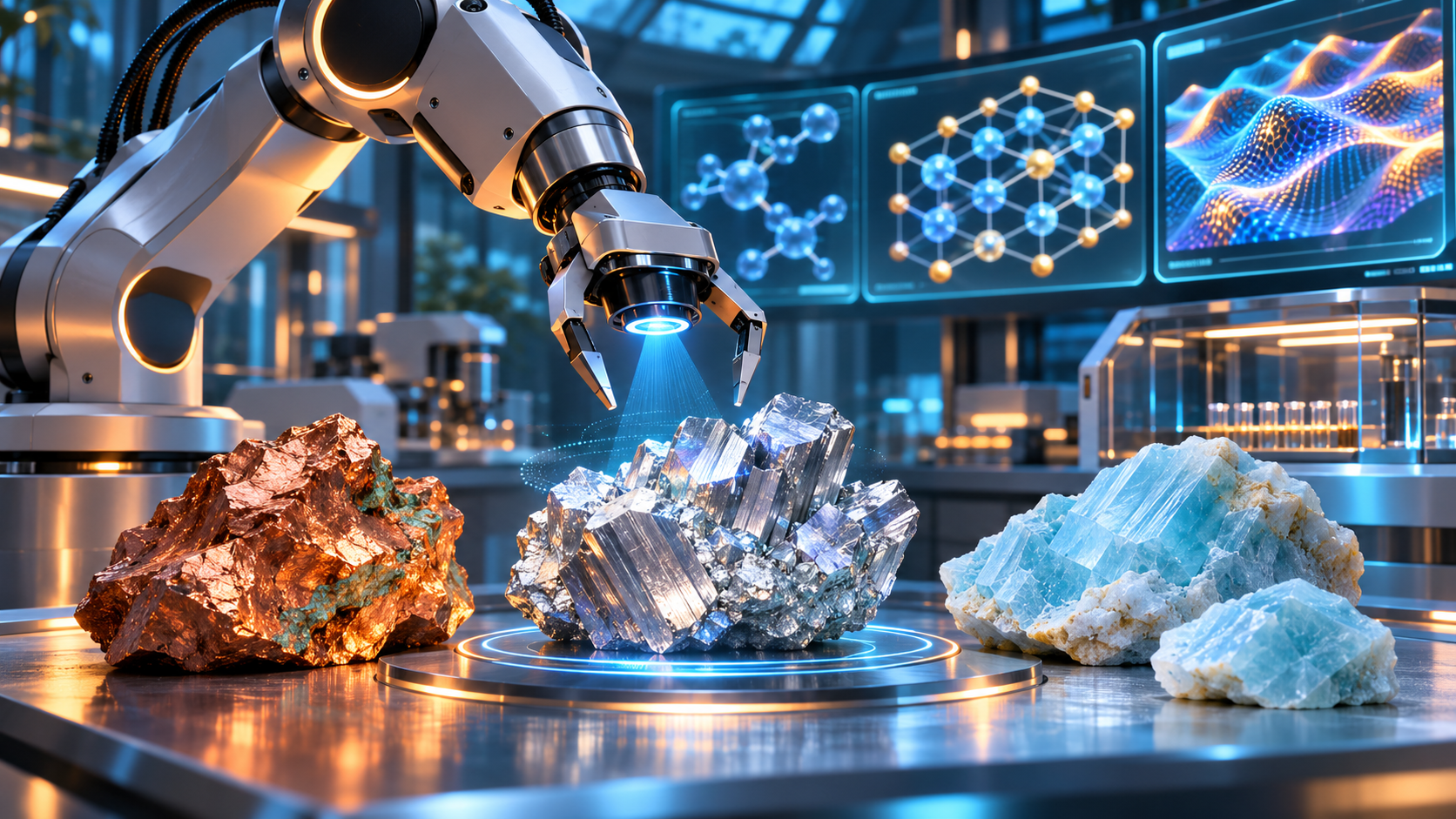
Artificial intelligence could help America break its dependence on Chinese critical minerals—not by discovering new deposits, but by inventing entirely new materials.
For decades, countries have competed for control over the natural resources that power the global economy.
Oil dominated the twentieth century. Today, critical minerals such as rare earths, lithium, cobalt, copper and antimony have become some of the world’s most strategically important resources.
These materials are essential for everything from electric vehicles and smartphones to fighter jets, missile systems, robotics and advanced semiconductors.
And one country has an enormous advantage: China.
China dominates the processing and refining of many of the world’s critical minerals, giving it considerable influence over global supply chains.
For the United States, this has become a major national security concern.
Washington is spending billions of dollars developing domestic mines, building processing facilities and securing alternative sources of supply.
But what if there’s another solution?
What if, instead of spending decades trying to secure scarce minerals, artificial intelligence could help scientists invent entirely new materials that reduce the need for them?
It might sound like science fiction, but it’s already beginning to happen.
And it could create an entirely new investment opportunity.
China’s Critical Minerals Advantage
China’s dominance in critical minerals goes far beyond mining.
According to the International Energy Agency, China is the leading refiner of 19 out of 20 strategically important minerals, with an average market share of approximately 70%.
Its position is especially strong in rare earths, which are used to manufacture powerful magnets found in electric vehicles, wind turbines, industrial robots and military equipment.
In 2025, China introduced export restrictions on several rare-earth elements, creating major concerns for Western manufacturers.
The message was clear: countries that depend on Chinese-controlled supply chains are vulnerable.
The traditional solution is to develop new mines and processing facilities outside China.
That’s necessary, but it’s also expensive and time-consuming. A new mine can take more than a decade to develop.
Now, a new approach is emerging.
Rather than simply finding more of the materials we already use, scientists are exploring ways to develop entirely new materials that can perform the same functions using different, more readily available elements.
And artificial intelligence could dramatically accelerate that process.
Meet Autonomous Laboratories: AI That Discovers New Materials
Most people associate artificial intelligence with ChatGPT, image generators and other software applications.
But one of AI’s most exciting applications is happening in the physical world.
It’s called an autonomous laboratory.
Traditionally, discovering a new material involves scientists spending months or years conducting experiments.
They combine different elements, test the results, analyze the data and repeat the process until they find something that works.
It’s expensive, labour-intensive and often painfully slow.
Autonomous laboratories are changing that.
These facilities combine artificial intelligence with robotics and advanced scientific equipment to conduct experiments with minimal human involvement.
Here’s how they work:
- AI identifies promising materials by analyzing scientific data and predicting which combinations might work.
- Robots conduct the experiments, mixing materials and testing their properties.
- AI analyzes the results and determines what to test next.
- The process repeats, potentially 24 hours a day, seven days a week.
The result is a laboratory that can test large numbers of potential materials far faster than traditional research methods.
Experiments that once required months of manual work may, in some cases, be completed in days or weeks.
Of course, discovering a promising material doesn’t mean it’s immediately ready for commercial use. Manufacturing and testing can still take years.
But accelerating the discovery process could fundamentally change how new technologies are developed.
And some of the world’s largest technology investors are already getting involved.
NVIDIA Is Backing the Next Generation of Scientific Discovery
One company attracting significant attention is Radical AI, a New York-based startup developing autonomous laboratories for advanced materials discovery.
In July 2025, Radical AI announced a $55 million seed financing, backed by investors including NVIDIA’s venture capital arm, NVentures, and RTX Ventures.
The company is developing technology that combines AI with robotic laboratories to discover materials for applications in defense, aerospace, energy and advanced manufacturing.
What makes Radical particularly interesting is its growing involvement with the U.S. government.
In 2025, the company announced a $1.2 million contract with the U.S. Air Force to accelerate the development of advanced metal alloys for hypersonic applications.
These materials must withstand extreme temperatures and pressures, making them difficult and expensive to develop through traditional research.
Radical also announced a memorandum of understanding with the U.S. Department of Energy in December 2025 to explore collaboration on AI-driven materials discovery.
While the agreement doesn’t guarantee future contracts, it highlights the government’s increasing interest in this technology.
Another company worth watching is Lila Sciences, based in Cambridge, Massachusetts.
Lila is developing AI-powered laboratories designed to accelerate scientific breakthroughs in chemistry and materials science.
The company attracted hundreds of millions of dollars in private investment in 2025, including backing from NVIDIA’s venture capital arm.
In one research program announced in 2026, Lila used its autonomous laboratory technology to test nearly 3,000 different catalyst formulations in approximately three months.
Catalysts are materials used to make chemical reactions happen faster and more efficiently. They’re essential to industries ranging from energy production to chemical manufacturing.
Lila’s research demonstrated how AI-powered laboratories can rapidly investigate thousands of possibilities and identify promising new materials.
These are still early-stage technologies, but the progress is remarkable.
We’re beginning to see artificial intelligence move beyond answering questions and generating content to actually helping scientists discover new things.
What If We Could Replace Some Critical Minerals?
This is where things get particularly interesting.
Imagine a future where American manufacturers no longer need to depend on Chinese rare earths to produce certain high-performance magnets.
Or where new battery technologies require substantially less lithium, cobalt or nickel.
Or where advanced materials used in military equipment can be manufactured using more readily available elements.
These aren’t entirely hypothetical ideas.
American companies are already developing rare-earth-free magnets, while newer battery chemistries are reducing dependence on certain expensive metals.
For example, Niron Magnetics is developing permanent magnets made from iron and nitrogen rather than rare-earth elements.
Meanwhile, lithium iron phosphate batteries have already demonstrated that electric vehicle batteries don’t necessarily need nickel or cobalt.
Autonomous laboratories could accelerate the discovery of similar alternatives across dozens of industries.
That doesn’t mean critical minerals are going away.
Many elements have unique properties that are extremely difficult to replace, and demand for numerous commodities will likely continue growing.
But it does raise an interesting question for investors.
What happens to the long-term demand for a critical mineral if scientists discover a cheaper, more abundant material that can perform the same job?
It’s something resource investors may eventually need to consider.
And it also highlights the opportunity emerging in the technology companies developing these discoveries.
A New Investment Opportunity Is Emerging
Over the past several years, investors have poured billions into artificial intelligence.
Most of that capital has gone toward semiconductor companies, data centers and software developers.
But I believe the next phase of AI could look very different.
Rather than simply building more powerful AI models, companies will increasingly focus on using those models to solve real-world problems.
And few problems are more economically important than discovering new materials.
Think about the potential applications.
An autonomous laboratory could help an automaker discover a cheaper battery chemistry, assist a defense contractor in developing a stronger alloy or help a semiconductor manufacturer identify materials that improve chip performance.
The possibilities extend across nearly every major industry.
Companies operating these laboratories could eventually generate revenue by providing research services, licensing newly discovered materials or partnering with governments and large industrial manufacturers.
It’s an intriguing business model.
Instead of owning a mine that produces one commodity, imagine owning a technology company whose platform could help discover valuable new materials across multiple industries.
Of course, this industry is still in its infancy.
Many companies developing autonomous laboratories remain privately held, and commercial adoption is far from guaranteed.
But with NVIDIA, major venture capital investors and the U.S. government committing capital to the sector, it’s becoming increasingly difficult to ignore.
The Next Great Race for Resources May Look Very Different
For centuries, nations have competed to control the natural resources beneath their feet.
That competition isn’t going away.
The United States will still need to develop domestic mining and processing capabilities to reduce its dependence on China.
But an entirely new front is opening in the race for critical minerals.
Instead of simply competing to control scarce resources, countries are beginning to compete over who can discover the materials that might replace them.
And artificial intelligence could dramatically accelerate that process.
I believe autonomous laboratories and AI-powered materials discovery are going to become an increasingly important investment theme over the coming years.
We’re still in the very early stages, and most of the companies leading this technological revolution are privately held.
However, I expect we’ll begin seeing new companies enter this space, including opportunities that could eventually become accessible to public-market investors.
I’ll be keeping my ear to the ground and watching this emerging industry closely.
And as interesting opportunities come across my desk, you can be sure I’ll keep SmallCapInvestor readers informed.
Because if there’s one thing I’ve learned from following emerging technologies, it’s that some of the most exciting investment opportunities appear long before the broader market understands their potential.
The next critical minerals revolution might not begin in a mine. It might begin in a laboratory.