
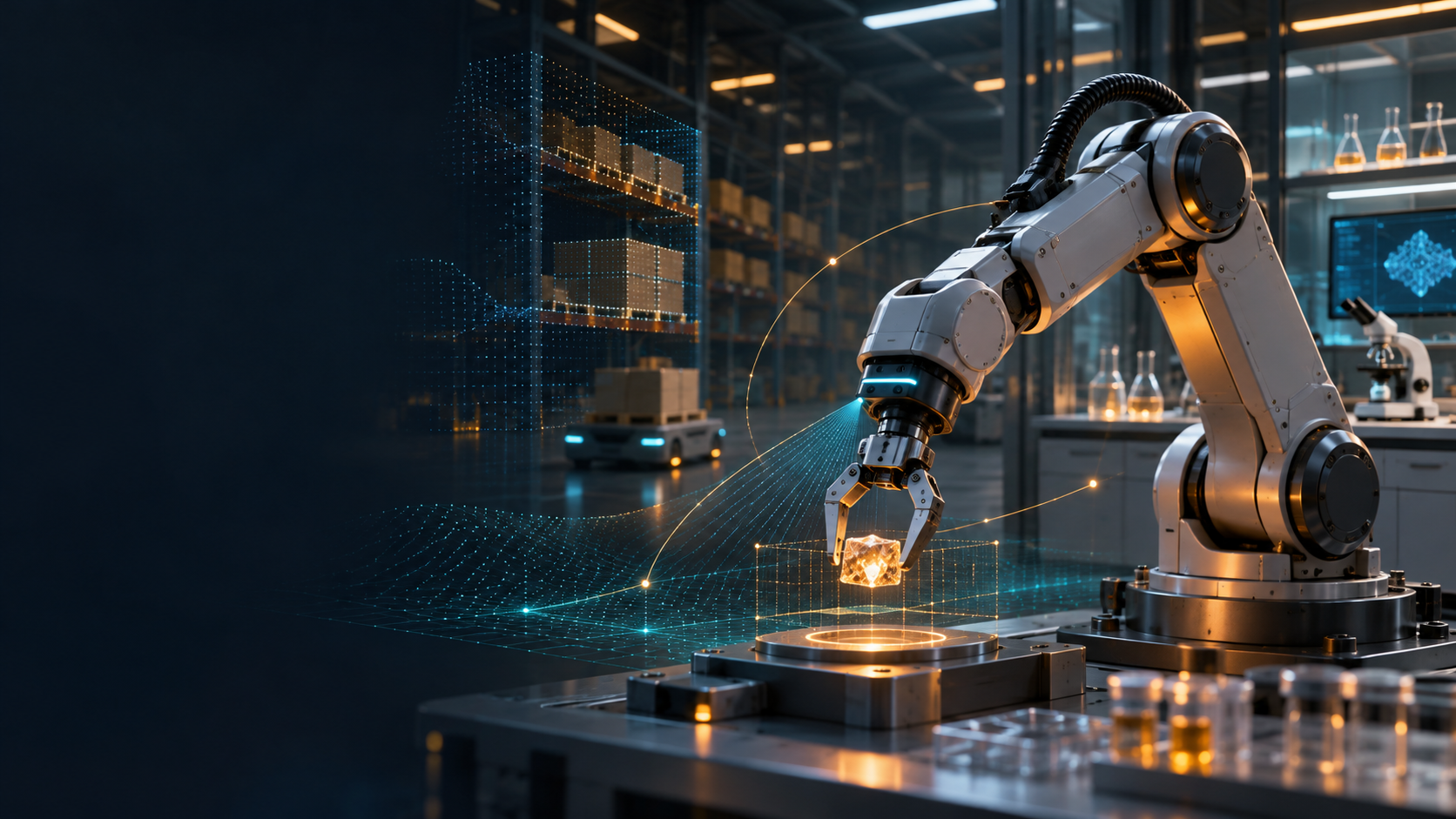
The next phase may be AI that can understand space, make decisions and act in the physical world.
Is the AI trade a bubble? I wrote last week that there is no simple yes-or-no answer.
AI can be transformative. Investors may still overestimate how quickly it will pay off, how much infrastructure the market needs, or which companies will capture the value. Only time will tell whether this cycle deserves the word “bubble.”
But investors don’t have to wait for a verdict. We can ask a more useful question: what comes next?
In my view, we are no longer in the first inning of AI stocks. The first wave around chips, cloud capacity and data centres has already delivered enormous gains in some of the best-known names. That doesn’t mean the AI opportunity is over. The next leg may simply be harder to find in the same obvious places.
I think investors should start paying closer attention to Physical AI: systems that bring AI out of the screen and into machines that sense, reason and act in the real world.
AI moves from answering to acting
A chatbot receives a prompt and produces text, images or code. Physical AI has to do more. It interprets a changing environment, tracks where objects are, chooses an action and checks the result. The system might be a factory robot, delivery vehicle, drone, tractor, warehouse fleet or automated laboratory.
That requires spatial understanding. A robot needs to know position, distance, orientation, depth, motion and contact. It must account for object shapes, workspace layout and the effects of its own movements. In a lab, the “world” also includes samples, instruments, temperatures and experiment results.
This is not a clean break from language models. They can interpret instructions, draw on technical knowledge and plan work. But they must connect to perception, robotics, simulation and real-time control.
Google DeepMind says its Gemini Robotics models combine language and visual understanding with the ability to reason about physical spaces and act through robots. NVIDIA CEO Jensen Huang has called Physical AI “the next frontier of AI.”
AI is beginning to interact with the physical economy. It can do more than write emails or summarize documents. It can help move a box, inspect a power line, tend a crop, assemble a product or run an experiment.
Why the timing is changing
Robots have been in factories for decades. What is changing is the intelligence around them. Better vision models, cheaper sensors, stronger processors and improved simulation tools could make robots more adaptable.
Instead of programming every movement for one narrow task, developers want systems that handle variation and learn workflows with less custom engineering.
Physical AI also needs different data. A text model can learn from documents. A robot needs examples grounded in movement and space: camera views, depth maps, positions, motion, forces, contact, failures and successful outcomes.
Collecting this data in the real world can be expensive. Companies are supplementing it with simulation and synthetic data. NVIDIA’s Isaac Sim and Omniverse tools, for example, simulate robots and generate synthetic training data in virtual environments.
Training models, simulating many scenarios and generating synthetic data can require substantial compute. But a robot does not need a giant data centre behind every movement.
A more likely setup is hybrid. Train and simulate centrally, then run fast, safety-critical perception and control near the machine. A robot avoiding a person cannot wait for a distant server to respond.
There is already a sizeable deployment base. The International Federation of Robotics reports 603,000 industrial robot installations in 2025, up 11%. Professional service-robot shipments rose 24% to nearly 250,000.
These figures include many robots that do not use foundation models. Still, they show that businesses are deploying robots at scale. Better sensing, software and autonomy could add value to that installed base.
The market size is harder to pin down. Arthur D. Little estimates the broader Physical AI market at about US$18 billion today, rising to US$60 billion to US$100 billion by 2030.
Other firms publish very different forecasts because they count different products, from robot hardware and software to autonomous vehicles. Treat these estimates as signals of interest, not a settled TAM.
The public companies to watch
There are few public pure plays focused only on Physical AI. Exposure is spread across chip and software platforms, established robotics companies and businesses applying autonomy in specific industries.
Their risks differ widely. Many still earn most of their revenue outside this theme.
NVIDIA (NASDAQ: NVDA) supplies computing platforms, simulation tools and robotics models. Qualcomm (NASDAQ: QCOM) is developing processors and edge-computing platforms for robotics and connected machines.
Both sell tools into the wider ecosystem rather than operate robot fleets themselves.
Teradyne (NASDAQ: TER) owns Universal Robots and Mobile Industrial Robots. They sell collaborative arms and mobile robots for factories and warehouses.
ABB (SIX: ABBN), FANUC (TYO: 6954) and Yaskawa Electric (TYO: 6506) are established robotics companies. Their hardware and customer relationships could benefit as robots gain more adaptive AI and easier simulation tools.
ABB and NVIDIA are already working on an industrial robotics simulation-to-deployment toolchain.
Symbotic (NASDAQ: SYM) applies robotics and AI to warehouses. Serve Robotics (NASDAQ: SERV) operates delivery robots. It recently announced a service offering based on robot connectivity, fleet data and real-world training data.
Deere (NYSE: DE) is bringing autonomy to agricultural equipment. Tesla (NASDAQ: TSLA) is developing Optimus alongside its autonomy work. Hyundai Motor (KRX: 005380), which owns Boston Dynamics, is investing in AI-enabled robotics.
These are very different bets. Some products work in commercial settings; other programs are earlier in development.
Autonomous laboratories are a more specialized example. XtalPi (HKEX: 2228) combines AI, high-performance computing and robotics for drug and materials research.
Ginkgo Bioworks (NYSE: DNA) said in November 2026 that it had made its first sale of an autonomous lab to a top-tier pharmaceutical company. In these labs, AI can choose experiments, robots run them and results guide the next round.
The system is doing more than moving objects. It is running a scientific workflow. The field is still early, so investors should look for customer deployments and repeat revenue, not just broad claims about future research.
The developer list extends well beyond public markets. Figure AI, Agility Robotics, Apptronik, Physical Intelligence and Skild AI are building humanoids, robot models or general-purpose autonomy.
Google DeepMind, Amazon and other large technology companies are also working on robotics. Public investors may have to look to suppliers, industrial incumbents or major customers for exposure.
The hard part is making the economics work
A convincing demo is not a profitable deployment. Robots must work safely and reliably at a cost customers can justify. They must handle failures, maintenance, downtime and the variety of real workplaces.
A robot that looks impressive on stage still has to do useful work thousands of times without constant human help.
I would look beyond product launches. Watch for paid deployments that expand, repeat customers, high utilization and fewer human interventions. Look for reliable uptime, measurable productivity gains and attractive service costs.
In autonomous labs, track validated experiments per dollar, reproducibility and time to a customer-qualified result.
Physical AI could become a major investment theme, but the path will not be smooth. Hardwar$e is capital-intensive. Data can be expensive to collect and may not transfer between robots or environments.
Safety standards and customer acceptance take time. Some impressive products will still fail to find a business model.
What comes after AI?
I don’t know whether the AI market is in a bubble. I don’t know which Physical AI companies will become the next generation of winners. But I think more AI systems will interact directly with the physical world.
The first wave put AI in the cloud and on our screens. The next may put it in factories, warehouses, farms, vehicles and laboratories.
Investors should not chase every company that adds “AI” or “robotics” to a presentation. The opportunity may broaden from building models to applying them where automation solves a real problem and earns a measurable return.
The AI trade may be moving beyond its first inning. The next one could be physical.